AK-47 Buyers Guide

The online version of the book by Robert Kay

  • Home
  • About
  • Author
  • Press

AK Slings

November 9, 2016 By Robert Kay

The sling for your AK is essential, whether you’re a seasoned tactical shooter or just a visitor to the range.

(If you do visit the range, you’ll see that few people use them. I don’t understand this.)

If I were to think of one item that will improve accuracy and stabilize your shot, this would be it.
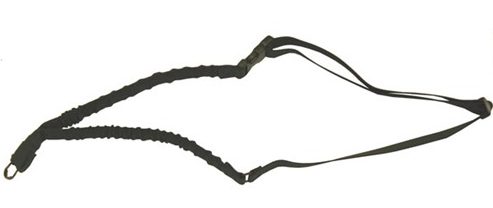
One-point-sling is popular with a number of tactical operators. This one is from BLACKHAWK!


The one-point-sling (see above) is popular with a number of tactical operators and BLACKHAWK! makes an excellent one.


My favorite is the two-point sling that offers an excellent combination of carry and comfort both for veteran shooters and beginners.

Depending on how you configure your sling to your rifle, you can carry it in just about any conceivable position, from the low ready to slung over your back.

You can also use it in an over-the-shoulder carry so that your hands are completely free to do other tasks.

There are a plethora of manufacturers, but I really like the two-point BLACKHAWK! Dieter CQD Sling.

Blackhawk has an impeccable reputation when it comes to designing gear for the tactical shooter. The Dieter CQD model sling was designed for BLACKHAWK! by tactical guru Duane Dieter.

The BLACKHAWK! Dieter CQD Sling stretches like a bungee cord and is really comfortable. (Courtesy BLACKHAWK!)

The CQD sling is a very sturdy item, constructed with 1.25-inch T-13 webbing, which is wider and more comfortable than standard fare. This item is designed for carrying your rifle either over your shoulder in a muzzle-up carry or muzzle-down carry.

The BLACKHAWK! Dieter CQD Sling differs from standard AK slings because it uses “HK style”, gated snaphooks.

The spring-loaded snaphook is made with heavy-gauge metal, and although it does take some dexterity to attach or remove, it’s very safe.

To secure it to the forward end of your rifle, you’ll need a sling swivel or a wire loop, depending on your rifle’s configuration.

Bottom line: It’s exceedingly comfortable to use.

MSRP is around $44.

This AK sling from Blue Force Gear is designed by Larry Vickers. (Courtesy Blue Force Gear)

The new Blue Force Gear Standard AK Sling also is a good bet. Designed by another tactical guru, Larry Vickers, what differentiates this sling from others designed for the AK is a pull tab that allows you to make adjustments on the fly. This option is handy at the range, but if you’re in the field and need to attend to business quickly and without distraction, it’s crucial.

It comes with a loop that utilizes a heat-resistant, non-marring, nylon-coated stainless-steel cable. This is a $25 value alone, so combined with the sling, I think it’s a good deal.

While the pull tab is a modern innovation, this sling has elements of the old and new. For example, the coyote brown-colored nylon strap hearkens back to the old Soviet days.

In addition, the hardware, which is super-durable polymer, matches the famous plum coloring of the old-fashioned Soviet furniture. The apocryphal story is that the Russians actually wanted black furniture, but the factory didn’t get its dye quite right. There are other variations of the story, so believe what you like.

for-traditionalists-arsenal-sells-a-good
For traditionalists, Arsenal sells a good old-fashioned military-style, Bulgarian sling, which works perfectly on this VEPR. (Robert Kay)

As I’ve been advocating in this book, a great deal has to be said for minimalism and the traditional, military style sling from Arsenal fits this definition. Fit, function, and construction are first class. It’s manufactured from canvas and comes in green with a black, anodized snap hook attachment. I found it easily adjustable and comfortable. If you’re not sure how to attach it, fear not, there’s a video that shows you how. Prices for these slings begin at $10 and go up to about $30 depending on whether the item is imported from Russia or Bulgaria or, whether it’s of nylon or canvas construction. The sling featured in the photo is $17. If you’re not using it with a traditional, wood stock, you may need a swivel sling loop or two to attach it to the rifle.

AK WIKQD Sling Mount

The AK WIKQD sling mount from RazorSix Tactical allows AR-type slings to be adapted to most AK rifles with a quick-detach (QD) system. It’s a very clever design that clamps onto real estate available on the gas block.

According to the company, the mount has been field-tested in combat conditions and has proven to be 100 percent reliable with no failures or accuracy issues. It works on virtually all AK variants, including AKS, AKM, RPK, Israeli and South African Galils.

It does not affect the accuracy or harmonics of the AK. Made from 6061 aluminum, it is anodized black and laser-engraved with the company’s diamond logo. Priced at $40, RazorSix offers a lifetime warranty on the product.

this-wikqd-mount-from-razorsix
This WIKQD Mount from RazorSix Tactical is placed on the gas block. (Robert Kay)

To install it, simply remove the gas tube and nudge the AK WIKQD into position.

I needed to use a screwdriver blade to force the clamp open a bit, which is all it took to slide it into place. You cinch it down with a Philips screw and a little Loctite. There’s a cavity for the QD mount.

I thought the little device worked perfectly. It’s about as forward as you can put a mount, and in my book this was a big plus, because it affords you more muzzle control.

Filed Under: Product Reviews

AK Trigger Upgrade

November 9, 2016 By Robert Kay

An AK trigger upgrade may be in your future. Although the standard trigger system (aka fire control group) is decent, with some modifications can be an excellent trigger. The modifications entail smoothing out a few rough edges on the hammer. If you’re interested in researching this, there are number of videos on this subject. R&R Targets has developed a good trigger based on the Tapco.

A better option is to purchase the AKT-EL trigger system from ALG, a subsidiary of Geissele, a company renowned for excellent AR 15 (and other rifle) triggers. (I own an AKT-EL system and love it). The standard version is priced under $65. You can also get the enhanced AKT-UL version which competition shooters will dig.  Krebs Custom also has an excellent trigger modified from the Geissele.

alg-defense-ak-trigger-r-161
The AKT fire control group has a distinct, lightning bow shaped trigger. (Courtesy ALG). A version of this is also available from Krebs Custom.

Instead of taking a file or sandpaper to the trigger, another option is to swap out the fire control group. There are some good videos that will show you, step by step, how to do so. Changing out your FCG is not an inordinately difficult task for someone who has a modicum of mechanical skills and common sense.

Why would you want to replace a decent trigger in the first place?

Some folks, especially those who have owned rifles or 1911 pistols with good triggers are simply fussy. Or they may want their AK to have a quick reset for rapid fire.

There are any number of reasons but it comes down to an individual’s specific needs or desires.

AKT-UL (Enhanced) features a lighter and crisper break than the standard AKT Trigger, making it ideal for precision shooting

Unlike some trigger sets for the AR, most AK triggers are not adjustable. One exception is the model from Red Star Arms, which can be adjusted as a one or two-stage affair.

A company called CMC Triggers  has a new drop-in style model specifically for the AK. It’s the first decent modular trigger for the AK that I’ve tested.

The only word of caution, and this goes for installing any third-party part in an AK, is be certain that the trigger you acquire will work precisely with your AK.

I installed a Red Star Arms trigger on a VEPR and eventually got it working, but it was a real chore to do so, meaning we had to take dremel and do quite a bit of grinding on the safety. This is not something for the beginner.

The Joys of Trigger Slap

Another reason to install a new trigger is if after you purchase your gun you experience “trigger slap.”

Trigger slap is a common occurrence in AKs. You’ll certainly know it when you feel it.

trigger-slap-afflicts-many-an-ak
Trigger slap afflicts many an AK. This illustration by Rick Davis shows how force from the bolt carrier transfers to the trigger. It can be resolved.

Trigger slap is the stinging sensation of the trigger springing back or “slapping” the shooter’s trigger finger during firing.

It’s a sharp, unambiguous jolt that can occur with every shot or intermittently, sometimes favoring a particular type of ammunition. It’s often misdiagnosed as an ammo problem.

It can be mitigated by changing out the trigger, or you can have a gunsmith or someone very familiar with an AK fire-control group fix it.

It’s caused, says AK maven Rick Davis, when there’s insufficient clearance between the hammer, trigger and the disconnector. When this happens, the force of the resetting hammer is transferred into the trigger through the disconnector, causing the trigger to abruptly “slap” forward.

Says Davis:

“If there’s too much material on the rear disconnector pad, it will lack adequate clearance between the bolt carrier, disconnector and trigger. This results in a chain collision between the bolt carrier, disconnector and the trigger. The energy is then transferred into the shooter’s finger, producing the ‘slap’ sensation.

removing-material-from-the-red-area
Removing material from the red area helps correct trigger slap. (Courtesy Rick Davis).

He says this can be corrected by removing just enough material on the rear of the disconnector near the spring well. Remove only enough to allow proper clearance, no more.

Lyle Keeney, founder of UltiMAK, has a slightly different take on the matter. Says Keeney:

“The only cause I’ve seen was that the camming angles between the hammer and the disconnector were such that the disconnector was being accelerated backward so violently that no amount of clearance would solve the slap. Only by reshaping the camming angles between hammer and disconnector, providing a more gentle rearward motion of the disconnector, was the slap eliminated entirely.”

Keeney states that it’s easy to check for adequate (disconnector-to-trigger) clearance by holding the trigger all the way back as you slowly pull the carrier back to cock the piece, or simply cock the hammer by manipulating it directly with the carrier removed.

If the trigger is not forced forward at all while cocking the disconnector over the hammer, you probably have enough clearance, and should therefore look elsewhere to solve the slap issue.

As alluded to above, if you’re not experienced, correcting trigger slap may not be a task you want to attempt.

However, smoothing out a gritty trigger is do-able, if you’re not aggressive about removing too much metal.

There are a number of videos that will show you how to smooth out the action by applying a little sandpaper or emery cloth. Graham Baates does a nice job with this video.

Filed Under: Chapter 5, Product Reviews

Magazines

November 9, 2016 By Robert Kay

The AK rifle has a well-deserved reputation for reliability. Making sure the weapon would fire upon demand under trying battlefield conditions, first time and every time, was one of the primary goals of the engineering team responsible for the design, development, and production of the AK-47. However, any rifle (or any machine for that matter) is only as reliable as its least dependable part. In the case of self-loading rifles, the device responsible for feeding ammunition to the breech mechanism is critical.

That part is called a magazine — not a clip, which in technical firearm terms is something different.

If the magazine assembly is faulty or poorly designed, the rifle cannot be relied upon to feed ammunition properly.

At the range or local plinking area, feeding malfunctions can be frustrating and lead to potentially dangerous conditions within the rifle. In a self-defense situation, they can cost you everything.

old-mag
A well-used AK-47 steel magazine. (Courtesy Wikimedia Commons)

There’s a vast array of magazines available for the AK today. Capacities range from two- or three-round box magazines meant for hunting, to drums that will hold 75 rounds or more. Originally made from steel, they also can be found with bodies made entirely from synthetics (various types of plastic) or a mixture of synthetics plus steel reinforcing at critical points, such as the front and rear locking lugs and the feed lips.

Regardless of body type, all magazines are supplied with springs made of steel. Nobody to date has managed to come up with a strong, durable, reliable spring made of polymer.

The classic Russian Bakelite magazines add a realistic, old world touch to your rifle.

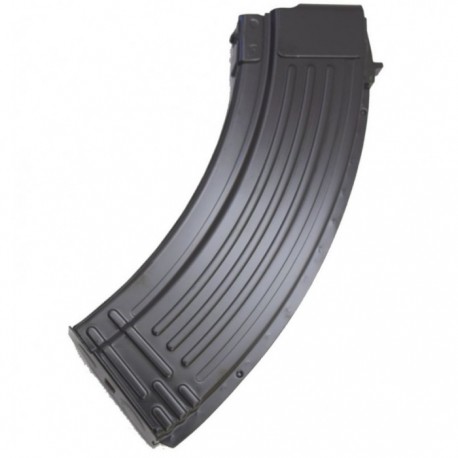
By far the most ubiquitous AK magazines worldwide are the familiar, curved banana-type designed by the Soviets and issued to Warsaw Pact forces as standard military equipment. Each standard AK magazine holds 30 rounds of ammunition. Originally mass-produced by various manufacturers in Eastern Europe, the classic 30-round AK box magazine is robustly built of steel, almost bullet-proof and, like the AK itself, relentlessly reliable.

They are also heavy, anywhere from 11 to 14 ounces empty, depending on the maker. By way of comparison, a standard 30-round aluminum M16 magazine weighs in at about 4 ounces, empty. A steel AK magazine loaded with 30 rounds of military ball ammunition weighs close to 2 pounds, which is quite a load of ballast to add to your AK for casual shooting offhand.

Russian slabside magazines are virtually indestructible.

By far the best are military surplus magazines. They were built with reliability and durability in mind, and for use under the most adverse conditions imaginable. You can find them from a variety of suppliers, in any condition, from old rust-buckets with dents and sometimes even bullet holes, to unissued as-new condition. Surplus military magazines in good condition are probably your safest bet, and come in steel and synthetic versions.

A tip: If you’re buying surplus, avoid magazines with dents. They can cause feeding problems. Rusty magazines are not desirable unless you like do-it-yourself cleanup and repair projects, assuming the rust is just a mild surface feature. Avoid magazines with deep pits or extensive damage inside and out.

Steel magazines can be found in many capacities, not just the 30-round variety. One of our personal favorites is the Hungarian 20-round steel magazine, though they are not easy to locate. (A good alternative  is the 20-round Tanker from Bad Element). Commercial five- and 10-round steel magazines are out there as well, but can likewise be difficult to find and are considerably more expensive than the ex-military 30-rounders. For example the Russian surplus is the best but it is a bit more pricey.

An Afghan Local Police recruit loads a magazine into an AK-47 rifle during a weapons course in the Latif district, Ghazni province, Afghanistan, April 1, 2012. The class was part of a three-week program that teaches candidates basic policing procedures, weapons handling and other skills necessary to protect and defend Afghan citizens. (U.S. Navy photo by Mass Communication Specialist 1st Class David Frech)

One note regarding the purchase of surplus steel magazines.

As alluded to above, good quality surplus is a great option. However, the operative phrase is “good quality”. Demand for high quality surplus mags has skyrocketed but the supply has diminished. The issue with anything used is that there may be problems with some of them functioning properly.

The 30-round Korean KCI Magazine is more than adequate for range work and self-defense.

The lesson is that it may be in your enlightened self interest to purchase new production steel magazines because it’s guaranteed that they will work, and if they don’t, you’ll get your money back or will be able to exchange them. This may not be the case with a used magazine. For new production steel magazines on a budget check out the Korean KCI Magazines. If you have a little more discretionary funds, the new production Romanian steel magazines are the best that you can buy.

Synthetic magazines have become increasingly common over the years, to the point where in the U.S. they are now at least as readily available as steel. Made by a variety of manufactures from a wide array of different types of plastic, they are lighter than steel, will not rust or dent, and can be had in a range of colors. Some of the best include the military surplus Soviet Bakelite-style, and Bulgarian “Circle 10” polymer magazines, both of which feature steel reinforcing at critical points.

imported-from-bulgaria
Imported from Bulgaria by Arsenal, this Circle 10 polymer magazine is easily recognized  from its “waffle” motif and the number 10 stamp inside the circle at the bottom. Priced at $45, it’s considered one of the best. (Robert Kay)

The Circle 10, which I’ve had a chance to use, is utterly reliable and has almost no play or wobble once inserted in the magazine well. This brand is easily recognized by their logo, the number 10 stamped inside a circle and the magazine’s waffle-patterned body. Priced at around $45, they are not cheap but it’s a question of getting what you pay for.

If you’re just plinking at the range, this inexpensive Tapco magazine will serve you well.

Steel reinforcing is especially desirable in magazines that will see a lot of heavy use or will be employed for self-defense, because the steel helps ensure that the critical parts will be less prone to failure due to wear and physical abuse.

Surplus magazines from Poland or Romania are a great bargain and can be purchased for as little as $15,00

Synthetic magazines are also commonly encountered without steel reinforcing elements, but most regard such as only suitable for casual range or plinking use.

I have used such magazines as supplied by U.S. companies Tapco, U.S. Palm, Pro-Mag and Magpul, and all performed well.

Every nation that builds AKs also builds magazines exclusively for their rifles. Generally, any military-surplus magazine in 7.62×39 or 5.45×39 will work in any standard AK of the corresponding caliber. But as we have seen with other AK parts, there can be exceptions. You may well have to experiment a bit to find out if a particular type of magazine is acceptable to your AK and its unique pedigree.

Choosing a magazine

A candidate AK magazine should be tested for fit. Make sure that both the rifle and the magazine are unloaded, and that the rifle is on safe with the muzzle pointed in a safe direction. The magazine should slide in to the magazine well on the rifle with a firm feel. The front lug should engage the front of the magazine well easily.

note-the-cheek-weld-displayed
Some magazines have “see-through” capability. Note the cheek weld displayed by the venerable Mrgunsngear. (Courtesy Mrgunsngear)

Rocking the magazine back into place, there should be a solid click as the rear magazine latch on the rifle engages the magazine locking tab on the rear of the magazine. There should be no or very little wobble of the magazine from side to side, and none from front to back.There will be some slight variation in fit for magazines of the same model and manufacturer, but it will be slight.

If several examples of the same type of empty magazine won’t lock firmly into place as described, you’d better try another make of magazine for your AK.

Once you’ve determined that they fit, take your candidate magazines to the range with your rifle. Nothing will substitute for running each of the magazines in the rifle in live fire to make sure everything operates correctly and reliably.

VEPR mags are not interchangeable with AKs so you’ll need to stock up on them separately.

If you do any research on the subject, you will find a wide range of opinion as to which magazines you should absolutely avoid purchasing. Yes, there are some real lemons out there. Some of them are even made by companies that manage to produce perfectly acceptable military magazines for other types of rifles, so be careful.

For example, many of the steel magazines made in South Korea are widely regarded as cheaply made and unreliable. Avoiding them might be a good idea.

Others report that they have had trouble with some makes of U.S. polymer magazines.

In the end, as with most things, you are best served by reading the various reviews and opinions and drawing your own conclusions.

The P-Mag from Magpul is a good, inexpensive item perfect for the range

And always do your own tests with a new magazine before you trust your well-being to it.

For our critical applications, we prefer to stick to magazines made by the same manufacturer as the rifle. It’s the safest bet.

Bolt-Hold-Open (BHO) Magazines

Anyone familiar with the AR platform knows that when you’ve expended your last round, the bolt remains open.  It’s always nice to know you’re out of ammo, and for safety’s sake you can visually check whether there’s a round in the chamber.

A standard AK does not have this feature, but you can go to a gunsmith who will be able to engineer a bolt-open solution.

Marc Krebs of Krebs Custom suggests that although A BHO follower is good for range or target work, it’s not optimal in situations where magazine changes must be done quickly.

SGM Tactical, a company out of Knoxville, Tennessee, manufactures bolt-hold-open magazines in .308, 7.62 and 223. It is one of the few companies that makes gear specifically for the VEPR as well as other AKs. I’ve been using its 7.62 BHO mag for about a year with a Saiga, and it works perfectly. Price is $34.95.

Option B is to add a bolt-open-feature to your own magazine by installing a special follower.

mags
This is a bolt-hold-open magazine from SGM (front) and WeaponTech Follower installed (rear). (Robert Kay)

A company called WeaponTech offers a drop-in replacement for standard AK47 metal and polymer magazines designed for 7.62×39.

WeaponTech is a venture between the inventor, Dimitri Mikroulis, and Primary Arms. Called the “WeaponTech BHO Follower,” you will need to disassemble your magazine to install it.

To do this, you take off the magazine’s floor plate, remove the spring, take out the original follower and add the new one designed by Dimitri. It’s not difficult — there are a number of videos that will show you how disassemble a magazine.

The main thing to watch out for is the spring inside the magazine. It’s under a lot of tension and it can pop out and impale your eye, if you’re not careful. Safety glasses are a good idea. Anyone who has taken apart a magazine will understand what I mean.

You can get a three-pack for $14.95. I think it’s a great product.

One last point to remember with a BHO magazine:

When you remove the magazine from the rifle, the bolt will snap shut, as it normally would after the firing cycle is complete.

I forgot that once and got a painful reminder as the bolt pinched my finger.

Filed Under: Chapter 5, Product Reviews

AK Adapters & Folding Stocks

November 8, 2016 By Robert Kay

You may decide that a fixed stock is not comfortable, in which case you should consider an AR-style collapsible stock. There are a slew of options for AK adapters ranging from collapsible systems to folders and combinations thereof. In this section we’ll look at some products that will help transform your rifle.

The AR-style collapsible stock offers an almost infinite latitude for operators of every physical description. With one click, a 6-foot, 4-inch shooter will be able to use the same rifle just as easily as someone who is 5’4.” It also comes in handy for those who need to adjust for body armor, heavy clothing, etc.

Second, the geometry of the AR buttstock provides a slightly elevated cheek weld compared to a standard AK. This affords more comfort and a sight picture that works both with the stock iron sights and, if you so choose, optics.

This cheek rise is extremely important to AK users says Justin McMillion of JMAC Customs, whose West Virginia-based company designs adapters for Arsenal 104 rifles and other variants. His adapter provides a 3/8-inch rise which allows users to better utilize iron sights. (The product also allows for a QD sling mount to be added).

In addition to JMAC Customs, adapters that will accommodate AR-style collapsible stocks are available from Vltor, Rifle Dynamics, CANIS Design Group, DPH Arms, and other manufacturers. R&R Targets makes one specifically for a Saiga shotgun.

jmac-customs-makes-an-adapter
JMAC Customs makes an adapter that provides a 3/8 inch cheek rise and QD mount for the Arsenal 104 and other variants. (Courtesy JMAC Customs)

Rifle Dynamics AK to M-4 Stock Adapter

An M4 or AR-15-style collapsible buttstock has become very popular with AK owners. Enter the Rifle Dynamics AK to M-4 system designed by Jim Fuller.

Not only is a collapsible stock more comfortable to use, it’s also better suited for shooters who want to utilize optics.

Here’s why: The original AK was designed for use exclusively with iron sights. Adding an optic to an AK was secondary and, hence, was never engineered to have the proper ergonomics to support “glass.”

As alluded to above, often an optic placed on side rail mount, or on a rail atop the receiver or dust cover, isn’t always ergonomic. The optic almost always sits too high or the stock simply sits too low to afford a cheek weld that provides a comfortable way to get a proper sight picture.

The operator has to compensate by moving up his or her cheek weld, which can be both uncomfortable and impractical. The Rifle Dynamics system rectifies this issue by changing the geometry of the stock so that it sits higher, thus giving your cheek a vertical boost.

rifle-dynamics-ak-to-m4
Rifle Dynamics AK to M4 Stock Adapter is a great way to add a collapsible stock to your AK (Robert Kay)

Gen 1 and Gen 2 

Gen 1 and Gen 2 Rifle Dynamics has two versions of its adapter. We installed the original “Gen 1” version of the product.

We were told the Gen 2 system places the stock at a slightly lower angle than Gen 1.

Jim Fuller, the man behind Rifle Dynamics, told me he did this because some users suggested that the angle of the Gen 1 was such that they couldn’t use the iron sights efficiently, though as a Gen 1 user I haven’t found this an issue.

Installing the RD System

Adding the adapter essentially means adding four bolts. However, there is a technique to getting it to fit perfectly. The real trick is making sure that you align the adapter squarely to the back of the receiver.

Installation was straight-forward, but there is some technique involved in aligning the adapter to the back of the receiver. (Robert Kay)

Part of the install process will entail adding Loctite to the bolt threads, so it will have to be done in an efficient manner. The end result is both aesthetically pleasing and very robust.

The adapter bolts right over the tang, so no modifications of the gun are necessary.

Utilizing the tang makes the assembly extremely strong. Additionally, any sling adapter that fits on the AR buffer tube should work with this set up.

Shooting my Saiga, after mounting the adapter, felt ergonomically correct. It was comfortable to use and an improvement over the collapsible buttstock that came with the rifle. I was able to use both the iron sights and a red dot with ease.

Installing the Right “Folder”

AKs with folding stocks (folders) are very much in vogue.

Why would someone need a folder?

If you’re a professional who jumps out of airplanes or does contracting work that necessitates concealability and compactness, then you really must have one. If you’re not someone who fits this description, but a folder saves you storage space and looks cool, then it may also be an attractive option.

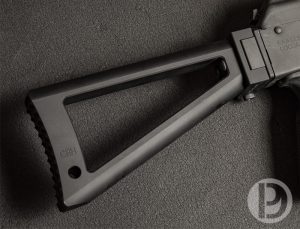
Triangle stocks look very cool but take a bit of getting used to. This  2-Bolt Triangle Stock for the 10-32 side folding adapter from Circle 10 AK runs $99.95

Side folders are available in several options that include a standard polymer buttstock on a hinge (from Arsenal) or as triangular or wire-style stocks.

In addition to side folders (both left and right), there are also “underfolders,” which, as the description implies, fold downward into a compact package. This design was originally used by paratroopers and other elite military units. The triangular folders and underfolders don’t provide a lot of cheek weld and in my experience are not comfortable. They are not recommended for the novice.Some of the more popular side folders combine the features of a collapsible stock and, of course, the folding element. These are both aesthetically appealing and quite comfortable to use.

A company called CNC Warrior makes particularly good side folding buttstocks in this category, designed in collaboration with and distributed by Bonesteel Arms LLC.

Likewise, one can also acquire an excellent folding adapter that accommodates a collapsible stock from a firm called StormWerkz.

Mako Group, an Israeli company, makes folding stocks as well as a combination folder-collapsible buttstock but I have found their customer service lacking.

(Note that before you add the folder, you’ll need an adapter that bolts to the back of the receiver, usually on the tang).

If you don’t want to mess with adding a separate folding mechanism and you simply want to attach a complete, folding, collapsible stock, Magpul’s new Zhukov-S is a good bet. It works both with the AK-47 and AK-74. With a 5-position pull adjustment, it’s sturdy, well-designed and available in five colors. Price is $99.95.

The Stormwerks folder is an excellent choice.

StormWerkz and Bonesteel/CNC folders

StormWerkz features a symmetrically sided wedge that the inventor, Josh Miller, says will allow the locking mechanism to wear evenly and last longer.

Installing the StormWerkz folder is easy. Simply torque down two 10/32 5/8-inch bolts that come with the device and cinch it down to the adapter with some Loctite. The result is a folder that is both functional and aesthetically pleasing.

It was simple to use and locked up tight at full length. It also locks up when folded. The stock was quite rigid and, short of using it to hammer down railroad spikes, should be quite durable.

Keep in mind:  to complete the job you’ll need an AR-15 buffer tube, castle nut and endplate. Price for the StormWerkz folder is $55.

The Bonesteel product line includes items designed for a variety of platforms, including the AR-15, AK /VEPR, Galil, PSL, Saiga and vz. 58. The folding mechanisms are integrated with Galil type stocks or with an M4 collapsible stock.

The appealing thing about the Bonesteel/CNC product for the VEPR is that it’s plug-and-play. Just bolt the whole enchilada to the back of the tang, add the pistol grip, and you’re ready to rock.

the-bonesteel-cnc-unit
The Bonesteel/CNC unit is a bolt-on affair. The VEPR version comes with a built-in stock adapter. (Robert Kay)

The Mil-Spec tube is machined from aircraft aluminum and pinned onto the folding mechanism — and it’s exceedingly light, just 12.5 ounces for just the hardware and 19.5 ounces or thereabouts with a buttstock attached.

Fit and finish on this item are superb — it has a shiny black anodized look that blends in perfectly with the VEPR color scheme.

The stock has six positions that will adjust to just about anyone, which is, after all, why you want a collapsible stock

If you really need to get up close and personal, you can bring the stock almost flush with the tang. It also has a memory-stop feature that allows for an instant extension to where ever you want to set it.

This is how it works: Each position has a threaded hole behind it for a cap screw to set a preset stop. Thus, if you never go beyond the No. 4 position, you won’t be fumbling around trying to find the right spot.

The The Bonesteel/CNC unit comes with a sling adapter. (Robert Kay)Bonesteel/CNC unit comes with a sling adapter. (Robert Kay)

I found the stock easy to manipulate without feeling like I was going to damage the hinge, if I somehow tweaked it the wrong way. It tucks to the right and folds closely to the rifle. Also included is a quick-detach (Q/D) sling swivel, which comes in handy.

It’s perfect for someone who wants to go the folder route without having to buy an extra adapter and the other associated parts.

VEPR owners need not feel left out. Krebs Custom has a terrific VEPR/M4 adapter for $84 .

If you add up all the components of the StormWerkz/Krebs combo above, you’ll pay $83.95 for the Krebs adapter and an additional $75 for the folder. That’s not counting an additional $40 for the tube, castle nut and endplate. Contrast that with the total for the Bonesteel/CNC folder, which runs about $149.

Circle 10 AK Push Button 2-Bolt Folding Stock Hinge

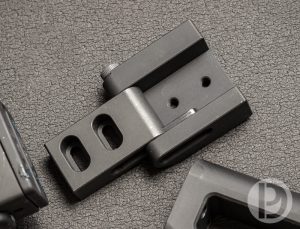
Circle 10 AK Push Button 2-Bolt Folding Stock Hinge is a good option for 10-32 2-bolt stocks.

I would be remiss if I didn’t mention the Circle 10 AK Push Button 2-Bolt Folding Stock Hinge for $54.95. I provides for much easier folding capability with your 10-32 2-bolt stocks. This hinge bolts onto any standard 10-32 2-bolt block such as ACE, Krebs Custom and Stormwerkz. (It includes all necessary mounting hardware).

Bottom line: If you do plan to purchase a side folder, consider which side the stock and hinge combination employ. A folder that folds to the right can interfere with the charging handle, and a left-sided unit may interfere with a side optic mount.

Filed Under: Chapter 5, Product Reviews

AR-15 Buttstocks for the AK

November 8, 2016 By Robert Kay

Adding an AR 15 buttstock to an AK is a popular exercise for AK users.

When selecting a buttstock, there are two main points to consider: comfort and weight.

With this in mind, we looked at five different popular options that we think will work splendidly with your AK.

Magpul CTR

It’s become de rigueur for Magpul to be everybody’s go-to furniture. When it comes to AKs, the CTR (compact/type restricted) buttstock is a very popular option. No wonder. It’s very solid and looks good. There’s no irritating wobble that less well-engineered stocks exhibit, and it provides a good cheek weld.

The A-frame design will help you avoid snags, and the release latch, which is shielded, is a great feature. I had no accidental release-latch encounters and the friction lock ensured a rattle-free experience.

The Magpul CTR is probably the most popular AR-style buttstock found on AKs. (Courtesy Magpul)

The CTR Mil-Spec model I reviewed comes with a removable 0.30-inch rubber butt pad. CTR has a larger butt pad available, if that’s what you need, but I don’t think this will be a problem, even with a 7.62x39mm AK.

If your goal is to find a reasonably priced, comfortable, well-constructed buttstock, then it’s hard to argue against considering a CTR, which weighs in at 252 grams.

The manufacturer’s suggested retail price is around $80, and you can get it on sale for as low as $60. Not a bad deal. As they used to say, “No one ever got fired buying IBM.” You could say the same about Magpul.

the-rogers-super-stoc
The Rogers Super-Stoc is light and has a lock-down mechanism that is easily adjustable. (Robert Kay)

Rogers Super-Stoc

The Rogers Super-Stoc may not be as popular as other brands, but that shouldn’t stop you from giving it consideration. It’s strong, lightweight, and sports a patented “Cam-Lock” system that is designed to remove excessive play, which is all too often found on collapsible stocks.

It has a removable recoil pad, sling loop, quick detach sling swivel mount and quick release lever, which unlocks the Cam-Lock and indexing pin with one motion.

It’s also got an innovative one-size-fits-all feature — it will accommodate both Mil-Spec and commercial buffer tubes. You’d think other manufacturers might have figured this one out. But you’d be wrong.

Rogers has hit upon a product that occupies a sweet spot in the buttstock spectrum. It’s a good-quality offering that’s going to appeal to competitive shooters and range rats while occupying an affordable niche at $75.

When I first took the stock out of the box, the first word to jump into my mind was “minimalist.” It reminded me of a fish skeleton. Not an ounce of fat on this baby.

It’s comfortable, though, and the butt pad provides for an ergonomic fit on the shoulder.

The tolerance on the buffer tube is super snug. Even if the Cam-Lock is not cinched down, it’s tight. The Cam-Lock on the Super-Stoc is reminiscent of the CTR design, which also has a front-locking lever. However, the Super-Stoc is engineered differently and, perhaps, even better.

The CTR utilizes a front-locking lever that secures the quick release lever. However, the Super-Stoc’s front Cam-Lock lever serves as an additional point of contact to lock down the stock to the rifle, making the connection even stronger.

I also liked the Cam-Lock lever’s ambidextrous capabilities. It comes stock on the right-hand side but, if you want to reverse sides, it’s easy to swap out.

It’s also very durable, performing admirably in a “Military Times” review called “Buttstock Bashfest.”

The only thing it doesn’t have is as much real estate as some of the others for cheek-weld purposes, but there’s certainly enough to make it work.

This product is used by Colt on some of its government-issue rifles.

At 186 grams, it’s tied for No. 1, as least heavy.

The Vltor EMOD A5 has a ton of real estate for the cheek. (Courtesy Vltor)

Vltor EMOD A5

Vltor makes excellent products and its EMod “A5” Combo Kit is no exception. It consists of a receiver extension, A5 mid-length buffer (standard weight), M16A2/A5 Action Spring, receiver end lock, and receiver end-lock nut plate.

I wanted a comfortable piece of furniture for precision shooting that could provide an ergonomically correct cheek weld for around $200. Having compartments that could secure ear plugs, batteries and the like was cool, but the paramount goal was comfort and utility.

The stock bears a striking similarity to the Lewis Machine Tool (LMT) SOPMOD model (and the B5 System’s clone). Vltor says that the A5 kit is perfect for piston style rifle systems, and it worked well with the AK, which is, indeed, a piston system.

The Vltor website provides a description of the specs that include a longer receiver extension with seven adjustment points and a specially weighted buffer utilizing the M16A2 action spring. I could only find five adjustment positions. (Where did the other two go?)

The EMod is approximately ¾-inch longer than a standard M4 carbine stock. It’s designed it for big people, with long arms in mind.

To move the stock up and down the tube, you need to depress a flat operation paddle with your fingertips. It’s not that sexy or convenient, especially if the tube refuses to budge. I like the friction lock on the Magpul and Rogers stocks much better—they are simply easier to operate.

The good news is that with these tight tolerances, there isn’t a lot of wobble, especially if the stock is slid all the way.

That said, there is a teeny bit of wobble in a fully extended position—more than on the Magpul and Rogers stocks we tested.

The cheek weld is great on this — equivalent to the SOPMOD model from LMT.

The bottom line is, I liked the stock. It’s expensive but has the benefit of extra real estate to place your cheek as well as two tubes for batteries and a tiny, flip-open storage box (suitable for earplugs) and a steel strike plate at the bottom. It was the heaviest, at 391 grams, of all the ones we tested. Price for the buttstock (as opposed to the kit) is $95.

the-mission-first-battlelink
The Mission First Battlelink Minimalist Stock and Grip. (Robert Kay)

Mission First Tactical Battlelink Minimalist Stock

The Battlelink Minimalist Stock caught my eye because of its light weight and innovative design.

The “Shepard’s Hook” is eye-catching and works quite well with an AK.

At about 185 gr (with the 8 feet of braided paracord) it’s lighter than the Magpul CTR – roughly equivalent to the “super” light Roger’s Super-Stoc.

Mounting it was a bit of task. The spring-loaded pin that frees up the stock to slip in the buffer tube is short and quite stiff. Using your fingers is brutal. Instead, you’ll need a channel lock or the butt end of a spoon to shift the pin far enough to slip the tube in. Once in, there’s no rotation or slippage and no need for a lock, as on the CTR, because the tolerances are so darn close.

The model I acquired, known as the BMSMILNRAT- BMS, has braided paracord strung from the tip of the buttstock to the base. The whole effect reminds me of those triangles we had to deal with in geometry class.

For the record, the woven paracord is officially called a “NEMO Rapid Assault Team Strap or NRAT Strap.”

I must say it looks pretty cool. The strap slightly obstructs the QD mount, but applying a little elbow grease will allow you access.

Mission First Tactical succeeded in building a distinctive, light, aesthetically pleasing product. I was concerned that the Shepard’s Hook would catch on my clothing, but, to date, I’ve yet to catch it on anything.

The top side of the stock has lot of real estate — even more than the Magpul CTR. The only thing I’m not crazy about is the difficulty of putting it on and removing it from the tube. If you’re not planning on swapping it out a great deal, this won’t be an issue.

I suspect you’ll see more of these on AKs as time goes by. MSRP is $84.99 — or $60 without the braided paracord.


LMT SOPMOD

Military-issue gear is by definition, pretty cool. It’s been vetted and battle-tested.

The LMT SOPMOD is no exception. LMT, according to its website, “is the sole provider of the SOPMOD Buttstock to the U.S. Special Ops Command, U.S. Army, U.S. Navy, U.S. Air Force, U.S. Marine Corps and other government agencies and bureaus.”

built-like-a-tank-and-battle-tested
Built like a tank and battle-tested, the LMT SOPMOD is the design everyone copies. (Robert Kay)

I decided to look at this buttstock because one of its clones, the B5 Systems SOPMOD, is popular with some of the top AK builders. It occurred to me that it would be better to look at the real deal—the original that the emulations are modeled after.

The stock has a very substantial feel about it. It’s made as one piece, and built like a tank. It has a great cheek weld and two watertight battery-access storage tubes that will keep the interior dry up to 66 feet. (Let’s hope you don’t put yourself in that position!) There’s a substantial rubber butt plate that reduces felt recoil and offers a no-slip surface against clothing, web gear and body armor.

As expected, there are quick-detach sling swivel mounts on either side. Installing the stock was easy and the fit was quite tight. No wobble in the least. The stock looks cool and is ergonomically correct. I can understand why they make clones of this.

If you ditch the storage tubes, which I suggest, you dock another 50 grams, bringing the weight to a very respectable 307 grams. At $200 it’s expensive, but the genuine article.

Filed Under: Chapter 5, Product Reviews

  • 1
  • 2
  • Next Page »

Buy The Book

How to Buy an AK 47 cover Rob Kay

Skip to a chapter in the book

  • Foreword–By James Reeves, Firearm Blog
  • Acknowledgements
  • Chapter 1: AK-47 Basics & Introduction
  • Chapter 2: How to buy the Best AK
  • Chapter 3: AK Parts Upgrades
  • Chapter 4: Optics & Mounts
  • Chapter 5: Parts Reviews
  • Chapter 6: Lubrication & Maintenance
  • Chapter 7: Where to Buy your AK
  • Chapter 8: FAQ & Glossary
  • Chapter 9: Online Resources

Copyright © 2025 · AK-47 Buyers Guide · Log in